How to play Catanova
An island trading and building game for two to six players, in a browser
Catanova is a free, browser-based island game for two to six friends. Each player settles a shared island, collects the resources their settlements produce, trades for what the dice did not give them, and builds towards ten victory points. A game takes about an hour. This page covers the whole of it: the opening placements, what everything costs, how a turn runs, and the handful of things this version does its own way.
In a hurry? Jump to building costs, the order of a turn, or the glossary.
Contents
Your first game
§A game happens in a private room. There is no lobby browser and no matchmaking: somebody creates a room and passes the code or the link around.
Getting everyone in§
- Find your room. Create room opens your lobby. Choose Join room for a friend’s code, or open their invite link.
- Choose your profile. Continue with Google or as a guest, pick a username and portrait, then share the room link.
- Ready, then start. Everyone else selects Ready. The host selects Start once the table is full and connected.
The opening placements§
Before the first roll, each player places a settlement and a road touching it. Everyone takes a first placement in seat order, then the order reverses for the second. Setup pieces are free.
Your second settlement pays immediately: you collect one resource from each neighbouring tile that produces. Placing last in the first round means placing first in the second, which is what keeps the opening fair.
Resources and building costs
§Five resources pay for everything. A tile produces when its number is rolled, for every player with a settlement or city on one of its corners, whoever rolled it. The desert produces nothing.
| Resource | Terrain | Pays for |
|---|---|---|
| Timber | Forest | roads, settlements |
| Clay | Hills | roads, settlements |
| Sheep | Pasture | settlements, development cards |
| Hay | Fields | settlements, cities, development cards |
| Rock | Mountains | cities, development cards |
What everything costs§
Costs are paid to the bank. You can build in any order, as many times as you can afford, during your own action phase.
| Build | Cost | What it gives you |
|---|---|---|
| Road | 1 Timber1 Clay | Extends your route by one edge. It must touch your own road or building, and it cannot pass through an opponent’s settlement or city. |
| Settlement | 1 Timber1 Clay1 Sheep1 Hay | Worth one point. Collects one resource from each neighbouring tile that produces. After setup it must touch one of your roads. |
| City upgrade | 2 Hay3 Rock | Worth two points in total, replacing the settlement’s point. Collects two resources instead of one. The settlement piece returns to your supply. |
| Development card | 1 Sheep1 Hay1 Rock | Draws a hidden card from the deck. You may buy more than one in a turn while you can pay and cards remain. |
Taking a turn
§A turn is three steps, and only the middle one is open-ended.
- Roll and collect. The matching tiles pay every player who touches them, not only you. Settlements collect one card; cities collect two.
- Trade and build. Trade and buy in any order, for as long as you have legal moves and the resources to make them.
- End your turn. Play passes on. The next player’s portrait shows what they owe the table, such as a roll or a robber move.
A playable development card can be used before you roll or during your action phase, but only one per turn. Finish its effect before doing anything else.
Rolling a seven§
No tile produces. Everyone holding more than seven resource cards discards half, rounded down; development cards do not count towards the limit.[2] Once the discards are in, the roller moves the robber to a different land tile and steals one random card from one eligible neighbouring opponent. That tile stops producing until the robber moves again.
A Knight moves the robber the same way without anybody discarding. See §5, Development cards.
What if the bank runs short?
If several players are owed a resource the bank cannot cover, nobody receives that resource from the roll. If only one player is entitled to it, they receive what remains, up to their entitlement. The other resources still produce normally.
The optional turn timer
New rooms start at 90 seconds; the host can choose 40, 65, 115 or 140 instead, or switch it off. When a turn expires the server completes whatever the rules require, using valid defaults, and ends the turn. It does not buy pieces or accept trades on your behalf. Setup placements are untimed, and a required discard has its own countdown.
Trading and ports
§Short one card for a city? Ask the table first; the bank is always there but it is expensive.
Trading with a player§
On your turn, select Trade, then the cards you are giving and the cards you want. Choose Open to offers to let anyone propose a return instead. Both sides must give something, and every trade includes the player whose turn it is.
Trading with the bank§
A settlement or city on either corner a port touches unlocks that port for you. A road along the coast does not. The picture on the port is what you pay; you can take any other resource the bank still has.
| Where | Rate | Example | Requirement |
|---|---|---|---|
| The bank | 4:1 | 4 Clay1 Hay | None. Always available on your turn. |
| General port | 3:1 | 3 Sheep1 Rock | Build on the port. Any one resource, three of a kind. |
| Resource port | 2:1 | 2 Timber1 Clay | Build on the port. Only the resource it names. |
The island carries four general ports, marked with a question mark, and one 2:1 port for each of the five resources.
Development cards
§Development cards are bought face down from a shuffled deck of 25. Select one in your hand to read what it does, then play it. Nothing needs dragging.
| Card | In deck | Effect |
|---|---|---|
| Knight | 14 | Move the robber and steal from an eligible neighbour. Nobody discards. Played Knights count towards Largest Army. |
| Road Building | 2 | Place two legal roads without paying for them, subject to your remaining pieces and the sites available. |
| Year of Plenty | 2 | Take two resource cards from the bank. They can be the same resource or two different ones. |
| Monopoly | 2 | Name one resource. Every opponent hands you every card they hold of that type. |
| Victory Point | 5 | One hidden point, counted from the moment you buy it. It is never played as an action. |
Rare card cases in this playtest
Road Building requires a legal first road and uses a second whenever one is possible. Year of Plenty takes a single card if that is all the bank has left, and cannot be played into an empty bank. These are provisional readings[3]; the compatibility ledger tracks the source questions still open.
Reaching ten points
§Ten points wins, and you must reach them on your own turn. If a trade or an award pushes you to ten while somebody else is playing, nothing happens until your turn comes round and you still have them.
| Source | Points | Notes |
|---|---|---|
| Settlement | 1 | Up to five of them, and the first two are free. |
| City | 2 | Two points in total, not two on top of the settlement it replaces. |
| Longest Road | 2 | Five or more connected roads. Held by one player at a time. |
| Largest Army | 2 | Three or more Knights played. Held by one player. |
| Victory Point card | 1 | Hidden from everyone else until the game ends. |
Roads score nothing by themselves. Only the award pays.
The two awards§
Longest Road goes to the first continuous route of at least five roads. Opponents’ buildings break a route, and two branches off the same trunk do not simply add together. Largest Army goes to the first player to play three Knights; Knights still in hand do not count.
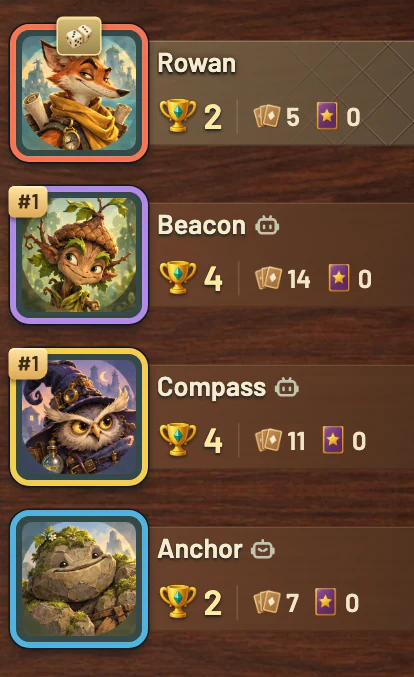
Both sit on the player profiles all game. To take one, you have to beat the holder’s total rather than match it, so a tie leaves an award where it is.[5] The full road rules cover what happens to a tie after a route is broken.
Playing against bots
§Short a player? The host can sit a bot in any open seat, and one will also cover a seat whose player has dropped out of the game.
Which bot turned up§
You find out by playing them. Three kinds exist and the game never tells you which one took the seat. One plays a steady game. One pays attention to whoever is in front. One plans every move around winning, chases both awards, and is genuinely hard to beat. Which turns up is the room’s draw, not a setting.
They think before they move§
A bot pauses before each move, longer over the decisions that matter and longest over the opening placement. Answering the instant the rules allow is the one thing that reads as software rather than as an opponent.
Setting up a room
§Three settings belong to the table rather than to a player. The host sets them before the game starts; everyone else can read them.
| Setting | Default | What it changes |
|---|---|---|
| Points to win | 10 | Anywhere from 8 to 15. Eight is a short game; fifteen is a long evening. |
| Turn timer | 90 seconds | A turn lasts 40, 65, 90, 115 or 140 seconds, or the host switches the timer off. The game plays a sensible move for anyone who runs out. |
| Natural or balanced dice | Balanced | Natural is two ordinary dice: every roll independent, seven the most common total. Balanced draws from a deck of all thirty-six dice pairs, removing each drawn pair and refreshing the deck after twenty-four rolls. Pairs matching the previous total have a lower draw weight. The next roll therefore depends on earlier rolls; rare totals can still be missed, and no frequency is guaranteed.[4] |
At the table
§Two small things that make a game feel like a table rather than a screen.
Your colour is yours§
Pick one of eight in the lobby, from the swatch on your own portrait. Nobody can take a colour somebody else is holding, and it is worth choosing deliberately: the pieces on the island carry no names, so colour is the only thing that says a road is yours. Your portrait wears it all game, and the cloth behind your name lightens when it is your turn.
Reactions§
Eight faces, a heart, a thumbs-up and a pair of eyes, drawn for this game rather than borrowed from your phone’s emoji font, so everyone at the table sees the same expression. Tap one and it flies across the board with your name under it. A short burst is fine; after that the button rests for a moment, which is the difference between a table and a chat room.
- Dying laughing
- Thumbs up
- Love
- Eyes on you
- Shocked
- Rage
- Devastated
- Begging
- Evil
- Clown
- Hype
Your profile and seat
§A profile that stays yours§
Google sign-in keeps your profile and enables friends. Guest profiles expire after seven days of inactivity, and a guest can link a Google account later to keep their username. They cannot add friends while still guests.
If your connection drops§
Let the game reconnect on its own, or come back with the same account and invite while the match is still active. The connection panel shows ping and sync status. Keep your guest session and browser storage while a game is running.
Common questions
§- What is Catanova?
- Catanova is a free online island-building game for two to six friends: collect resources, trade, and build your way to ten points. It is an independent game with its own artwork, rules text and interface, not an official CATAN game.
- Is Catanova free to play?
- Yes. The whole game is free, there is nothing to buy inside it, and no part of the board is held back. You can start a room as a guest without making an account.
- Can phones and computers play together?
- Yes. Open catanova.io in any modern browser and join the same private room from a phone, tablet or computer. Nothing is installed. You need an internet connection while you play.
- How many players do you need?
- Two to six. Three and four player games follow the familiar rules, and four to six can play Big World, a larger island with paired turns at five and six. Two player games are our own option, on the same island and to the same ten points, without neutral players.
- Can I play on my own, or fill an empty seat?
- Yes. The host can add a bot to any open seat, and bots also cover a seat if somebody loses their connection mid-game, handing it straight back when that player returns. There is no public matchmaking: rooms are private and you share a code or a link.
- What happens if someone disconnects?
- After about a minute, a bot covers their turns while someone remains at the table. They resume the current game state when they reconnect, including moves made by the bot. If everyone disconnects, play pauses and the room is abandoned after three minutes without a return.
Glossary
§Everything this page and the game call things, in one place.
- Bank
- The shared supply everything is bought from and traded with at 4:1.
- Bot
- A seat played by the server rather than a person. Added by the host, or covering somebody who dropped.
- City
- An upgraded settlement. Two points, and it collects two of a resource instead of one.
- Development card
- A hidden card bought from the deck: a Knight, one of three one-off effects, or a hidden point.
- Hand limit
- Seven. Roll a seven holding more and you discard half, rounded down. Development cards do not count.
- Harbour
- A port on the coast. Build on either corner it touches to trade at 3:1 or 2:1.
- Host
- Whoever created the room. Sets the rules, adds bots, starts the game.
- Largest Army
- Two points, to the first player to play three Knights, then to anyone who passes them.
- Longest Road
- Two points, to the first continuous route of five or more roads, then to anyone who passes it.
- Pips
- The dots under a number. Five dots means five of the thirty-six dice combinations make it, so it pays often.
- Production
- What a tile pays out when its number is rolled.
- Resource
- Timber, clay, sheep, hay or rock. The five things everything is built from.
- Robber
- The piece that stops a tile producing and steals a card. Moved on a seven or by a Knight.
- Room code
- Four characters that let a friend join your lobby. The invite link does the same.
- Setup
- The opening. Each player places a settlement and a road in order, then again in reverse, and the second settlement pays out.
- Victory point
- What you are counting to ten. Settlements, cities, the two awards and hidden point cards all give them.
See also
§- The rulebook, which carries every rule as the code enforces it, including the edge cases this page leaves out.
- The compatibility ledger, for the places Catanova had to choose a reading, and why.
- Playtest limitations, for what is not finished yet.
- The source on GitHub: the server, the rules package and this page.
Notes and references
§The places where this page describes a decision Catanova made, rather than a rule everybody already knows.
- ↑The island generator, and the constraints it places on numbers and terrain. Rulebook, board setup.
- ↑The hand limit, and what counts towards it on a seven. Rulebook, the robber.
- ↑Where the published rules leave a case open, the reading Catanova took and why. Compatibility ledger.
- ↑How the balanced deal is built, and what it does and does not change. Rulebook, dice.
- ↑Ties, and what happens to an award once a route is broken. Rulebook, longest road.